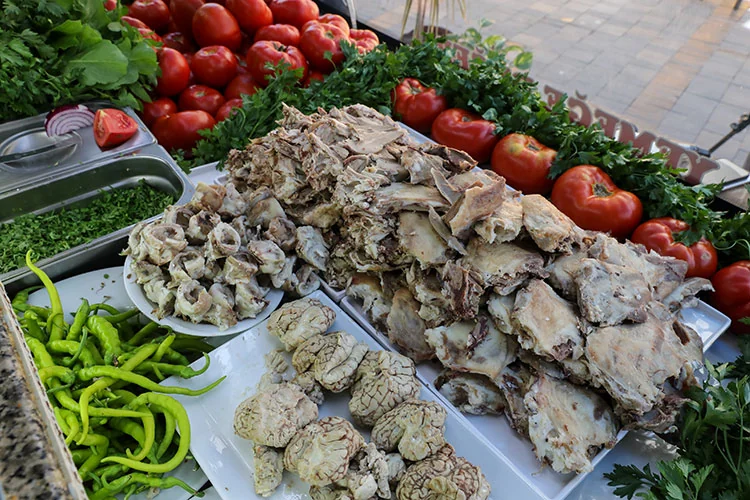
Turkish sogus, known locally as kelle söğüş or İzmir söğüş, is a cold street-food dish prepared with cooked lamb head meat and offal such as tongue, cheek and brain. The meat is served cold with fresh vegetables, cumin and other seasonings, usually inside a small flatbread wrap.
Söğüş is strongly associated with İzmir’s street-food culture. Unlike many Turkish offal dishes that arrive hot at the table, söğüş is deliberately served cold, and the fresh vegetables and spices are an important part of its balance.
In August 2026, I visited Uğur Usta Seferihisar Söğüşçüsü in Seferihisar and had the opportunity to speak with Uğur Usta in detail about how he prepares and serves söğüş. The photographs in this article are my own.
What Is Turkish Sogus?
Turkish sogus begins with lamb head meat that has been cooked beforehand and then cooled. Depending on the shop and the order, a serving can include tongue, cheek and other tender head meat as well as brain.
Because the meat is eaten cold, söğüş is very different from grilled lamb, kebab or kavurma. It also differs from hot offal dishes such as kelle paça soup.
For someone who has never eaten cold cooked meat before, the idea can sound unusual. In my experience, however, the combination of fresh vegetables, onion and especially cumin changes the character of the meat considerably.
Why Is Söğüş Associated With İzmir?
Kelle söğüş can be encountered outside İzmir, but it has a particularly visible place in the city’s street-food culture. The İzmir Provincial Directorate of Culture and Tourism includes kelle söğüş among İzmir’s characteristic street foods.
Official İzmir tourism information also describes söğüş made with parts such as tongue, cheek and brain together with fresh vegetables and seasonings.
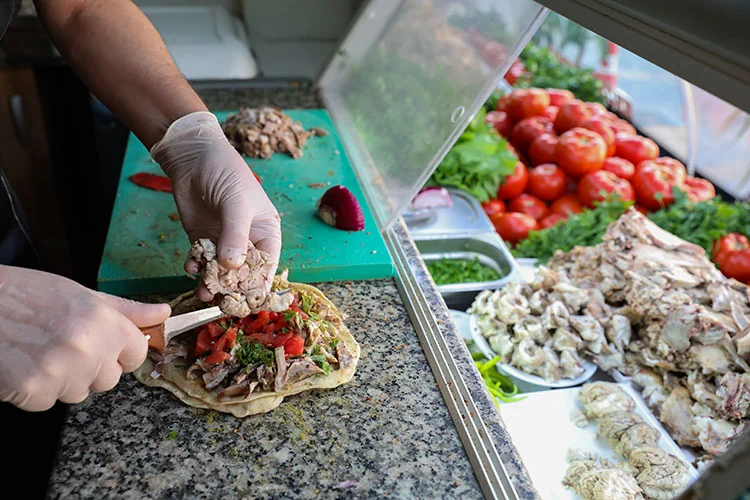
For me, söğüş feels less like a formal restaurant dish and more like a food connected with everyday İzmir life. You can see the ingredients at the counter and watch the dürüm being assembled in front of you.
What Goes Into İzmir Söğüş?
The exact combination can vary by shop and customer preference. During my conversation with Uğur Usta, the main ingredients he described were:
- lamb head and cheek meat
- tongue
- brain
- purple onion
- tomato
- parsley
- cumin
- salt
- optional hot red pepper
- söğüş flatbread
One detail Uğur Usta emphasized was the onion. In his own shop, he told me he uses purple onion rather than white onion for söğüş. I treat this as his own professional practice rather than a rule that every söğüş shop must follow.
Fresh Ingredients: What Uğur Usta Told Me
When I asked Uğur Usta what makes a good söğüş, one of the first things he talked about was freshness.
He explained that, in his shop, he does not cut a full day’s supply of vegetables when he opens in the morning. Instead, he prepares smaller quantities, keeps the cut vegetables cold and cuts another fresh batch as they are used.
He described roughly three to four hours as the quantity of vegetables he personally prefers to prepare at one time. This is Uğur Usta’s shop practice and experience, not a universal food-safety rule.
Why Is the Brain Cut to Order?
The brain was one of the most interesting details in our conversation. Uğur Usta told me that he does not cut the brain in advance for the whole day. He slices it while preparing the individual order.
In his experience, very fresh cooked brain is extremely soft and can begin to break apart even under the knife. He described its texture as almost buttery and spreadable.
He considers a noticeably firm texture a warning sign when judging the product he is working with. I would not use texture alone as a general food-safety test at home, but his explanation helped me understand why an experienced söğüş maker handles brain differently from tongue or cheek meat.
How a Söğüş Dürüm Is Prepared
I asked Uğur Usta to describe the process from the moment a customer places an order.
First, he places a round söğüş flatbread on the work surface. He adds sliced tongue, cheek and lamb head meat. The brain is then sliced at that moment and added to the dürüm.
Depending on the customer’s preference, purple onion, tomato, parsley, cumin, salt and hot red pepper are added. A second piece of flatbread is then used to close the dürüm before serving.
According to Uğur Usta, söğüş flatbread is smaller and more substantial than the thin lavaş commonly used for many other Turkish wraps. For that reason, he uses two pieces of bread for a söğüş dürüm.
Dürüm or Plate?
Söğüş can also be ordered as a plated portion.
Uğur Usta told me that for a plated serving he places a söğüş flatbread underneath, then slices tongue, cheek and head meat over it. The seasoning goes onto the meat, while the vegetables are sliced and served alongside.
However, the dürüm is much more popular in his shop. He estimated that around nine out of ten orders are for the wrap rather than the plated version. This is his estimate for his own business, not a statistic for every söğüş shop in İzmir.
What Does Söğüş Taste Like?
I enjoy söğüş very much, but its flavor can be difficult to imagine if you have never eaten cold cooked meat before.
Someone trying it for the first time might expect cold lamb and offal to leave a heavy or greasy sensation in the mouth. In my experience, a good söğüş does not taste that way.
Purple onion and tomato add freshness, while cumin is especially important for me because its aroma balances the stronger character of the offal. The different parts also bring different textures: tongue is firmer, cheek and head meat feel more traditionally meaty, while brain is much softer and creamier.
The result should not be judged as though it were grilled or roasted lamb. Söğüş has its own balance: cold meat and offal, fresh vegetables, aromatic cumin and soft flatbread eaten together.
Is Söğüş Served Hot or Cold?
Söğüş is eaten cold. The head meat and tongue are cooked beforehand and cooled before being used for service. The vegetables are added fresh rather than cooked together with the meat.
This cold serving style is one of the characteristics that separates söğüş from many other meat and offal dishes in Turkish cuisine.
Can You Order Söğüş Without Onion or Cumin?
You can ask a shop to change the ingredients according to your preference.
Uğur Usta joked with me about customers who ask for söğüş without onion or cumin. From his point of view, those ingredients are so important to the flavor that removing them changes the character of the dürüm considerably.
After eating söğüş myself, I particularly understand his point about cumin. For my taste, cumin and onion are among the ingredients that bring the meat, brain and fresh vegetables together.
What to Drink With Turkish Söğüş
Ayran is an easy pairing with söğüş. Its cold and lightly tangy character works well alongside the seasoned meat and vegetables.
Şalgam is another option for diners who prefer a saltier and more assertive drink with Turkish street food.
My Experience With İzmir Söğüş
Söğüş is one of those foods that makes more sense after you watch someone prepare it.
Seeing the tongue, cheek, head meat and brain separately at the counter makes it easier to understand how several textures come together in one dürüm. Watching the brain being cut at the moment of preparation also gave me a clearer idea of why freshness matters so much to an experienced söğüş maker.
For me, the most important flavor combination is the cold meat with onion, tomato and especially cumin. The vegetables prevent the dürüm from feeling one-dimensional, while cumin balances the characteristic aroma of the offal.
If you already enjoy Turkish offal dishes but have only tried them hot, İzmir söğüş offers a very different experience.
Söğüş and İzmir Street-Food Culture
Söğüş sits comfortably beside other foods strongly associated with İzmir, including boyoz, gevrek, kumru and kokoreç.
But it has a character of its own. It is cold rather than hot, combines several textures from the lamb’s head and depends heavily on the contrast between meat, vegetables and spices.
For someone exploring İzmir cuisine beyond its better-known bakery foods and sandwiches, kelle söğüş shows another side of the city’s street-food tradition.
Explore More Turkish Food Traditions
For more regional food guides, explore my articles about İzmir cuisine, kelle paça soup, kokoreç, and broader Turkish cuisine.