Turkish raki is often introduced to visitors as a strong anise-flavored spirit. That definition is correct, but it explains only the drink in the glass. It does not explain the table around it.
I have drunk rakı many times at home with friends, in meyhanes, and at simple tables with only a few foods beside it. Living in Seferihisar, an Aegean coastal town, also means that rakı culture is something I encounter in everyday restaurant and meyhane life rather than only through books.
For me, the most important part of drinking rakı is not the bottle. It is the conversation.
Rakı has an intense aromatic character and a high alcohol content, so I never think of it as a drink to finish quickly. A good rakı evening develops slowly as food arrives, glasses are refilled, and conversation continues. That is why the Turkish expression rakı sofrası, or rakı table, describes the experience better than simply saying that people are drinking alcohol.
What Is Turkish Raki?
Rakı is a traditional Turkish distilled spirit whose defining aroma comes from anise.
Current Turkish food rules define rakı much more narrowly than “an anise drink.” It is produced in Turkey from suma, or a mixture containing suma, and distilled with anise grown in Turkey in traditional copper stills. Suma itself is a grape distillate produced in Turkey.
The rules also set a minimum alcohol level of 40% by volume. They prohibit coloring, flavoring substances and other additives in rakı. The name is additionally registered in Turkey as a protected designation of origin.
You can read the current Turkish Food Codex notice and the TÜRKPATENT registration for rakı for the official framework.
These production rules are one reason I do not describe rakı simply as “Turkish ouzo.” The two drinks share anise and some Aegean table habits, but they have distinct legal identities and cultural settings.
Why Does Rakı Turn White When You Add Water?
Rakı is clear in the bottle, yet it becomes cloudy and milky after water is added. The change comes from anethole, one of the main aromatic compounds associated with anise.
Anethole dissolves well in a strong alcohol solution. Once water lowers the alcohol concentration, the compound becomes less soluble and forms tiny droplets that scatter light. The same effect appears in several other anise-based spirits, including ouzo.

What a Rakı Table Means to Me
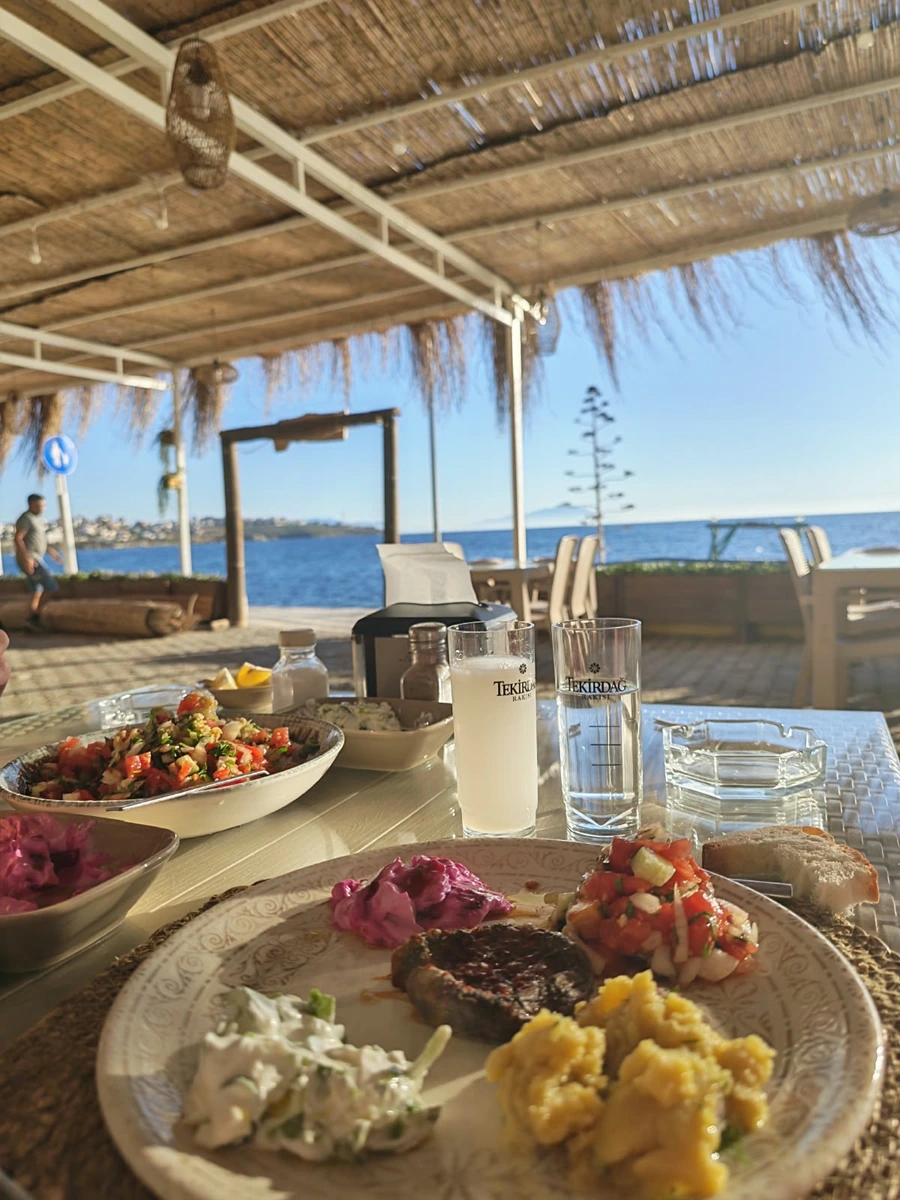
A rakı table is not simply a dinner table with alcohol placed on it. At the tables I know, rakı sets the pace of the evening. Food, drinking and conversation move together.
This is one reason I prefer drinking rakı in a salaş meyhane, an informal and unpretentious meyhane. I do not need an expensive room or polished presentation. Good food, patient service and people I enjoy talking with matter much more.
Without conversation, a rakı evening loses much of its meaning for me. Because the drink is strong and aromatic, I prefer to consume it slowly and with food. The social side of the table gives that slow pace a purpose.
This slower style of eating also connects naturally with the wider traditions I discuss in my Turkish food culture guide.
What to Expect at a Turkish Meyhane
A good meyhane has its own rhythm. Around Seferihisar, the places I visit usually prepare the table before guests sit down, with plates, cutlery and drinking glasses already in position.
Cold meze, rakı and conversation often begin the evening. Hot dishes or a main course can arrive later, so there is no need to place every dish on the table at once.
Experienced meyhane waiters also work differently from staff in a fast-turnover restaurant. A rakı table can remain occupied for hours, which makes patience and timing important. In more service-oriented places, waiters may watch the glasses and return when another pour seems appropriate instead of repeatedly interrupting the table.

If guests prefer to handle the bottle themselves, they can normally say so at the beginning. Otherwise, the waiter may take a more active role in the service.
Saki, Tek, Duble and Karar: Rakı Table Vocabulary
Rakı service has its own vocabulary. Understanding a few terms makes a first meyhane visit easier.
- Saki: the person who takes responsibility for pouring rakı at the table.
- Tek: a smaller serving of rakı.
- Duble: a larger serving.
- Karar: a pour between tek and duble.
- Sek: drinking rakı without adding water.
Some rakı glasses I encounter in meyhanes have reference lines that help with serving size. I would not treat those markings as a universal standard for every glass in Turkey, but they are common enough to be useful for visitors to recognize.
Among experienced rakı drinkers I know, an older or more experienced person may naturally take the saki role. Younger guests repeatedly pouring only for themselves can be viewed as poor manners at a traditional table. This is social etiquette learned through experience, not a formal national rule.
How I Prefer to Drink Rakı
There is no single correct water-to-rakı ratio because personal preference matters. Some people add water, while others use water and one or two ice cubes, especially during a hot Aegean summer. Drinking rakı sek, without water, is another option.
Personally, I often ask for an ehli keyf.
What Is an Ehli Keyf?
An ehli keyf is a chilled holder that surrounds the rakı glass. The glass sits in the center while the cold outer section keeps it cool from the outside.
I like this method because the rakı stays cold without continually adding melting ice. As a result, the dilution changes less during a long evening.
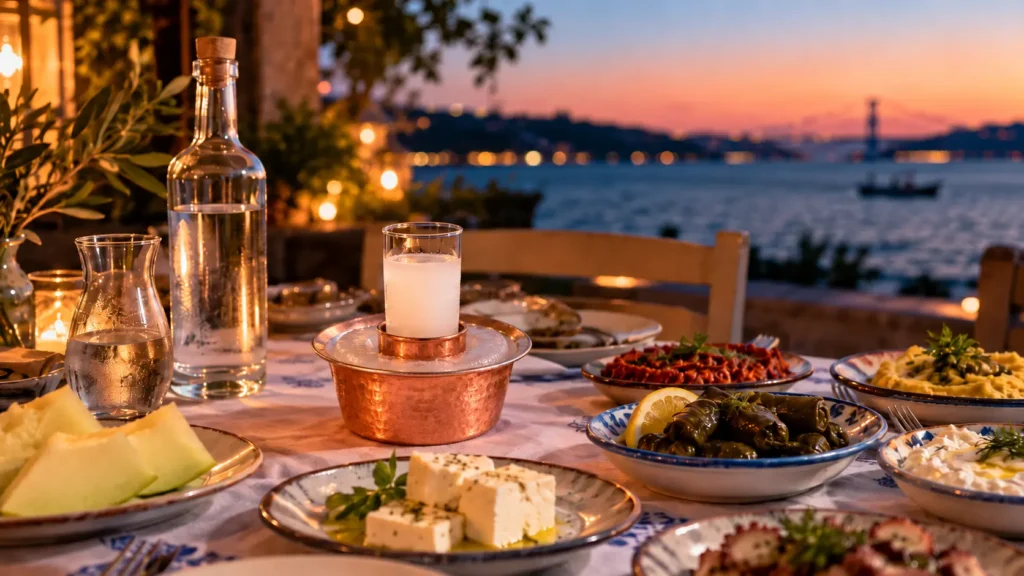
Ehli keyf is a small detail, but it represents the practical side of meyhane culture that generic descriptions of rakı often miss.
What Do You Eat With Turkish Raki?
There is no single correct rakı menu. Season, location, the kitchen and the style of rakı can all change what appears on the table.
In Seferihisar and other Aegean coastal towns, seafood naturally has a strong presence. Calamari, shrimp, grilled fish and sea beans are foods I regularly encounter beside rakı.
Cold dishes are equally important. Cheese, olive-oil vegetables and other Turkish meze let the table continue without making every course heavy.
My Pairing Preference Depends on the Rakı
I change the food depending on the style of rakı I am drinking. With fuller styles, including some göbek and multiple-distilled rakıs, I prefer a more substantial table with several mezes and a main dish such as fish, meat or chicken.
Yaş üzüm rakısı leads me in a different direction. White cheese with melon or watermelon can be enough, while a cheese plate and fruit plate create more combinations without making the table heavy. If you want to explore the cheese side further, see my guide to Turkish cheese.
These are personal pairing preferences rather than official rules for how rakı must be served.
Rakı Table Etiquette: Unwritten Customs I Learned Over Time
Some of the most interesting parts of rakı culture never appear on a menu. I learned them by sharing tables with people who had been drinking rakı for many years.
Starting the Table With Şerefe
When the first glasses are ready, someone at the tables I know will often say şerefe and raise a glass. The others join the toast before taking the first sip.

Another custom I was taught is more symbolic. If a friend we wish could be there is absent, some people gently touch the base of the glass to the table before drinking. At the tables where I learned the gesture, it works like a toast to the missing friend.
Older rakı drinkers have also explained şerefe to me as a promise of trust: what is discussed at the table stays at the table. I do not present that explanation as the literal dictionary origin of the word. Instead, I see it as rakı-table folklore that expresses the confidence expected between the people sitting together.
Keep Conflict Away From the Table
One lesson has been repeated to me many times: a rakı table is a bad place to provoke a serious argument. Rakı is a strong alcoholic drink, and heated subjects can become harder to manage as an evening continues.
For that reason, the older drinkers who taught me rakı etiquette preferred conversation without deliberately creating tension. The ideal is a table people remember for the company, not for a fight.
Drink at the Rhythm of the Table
The table also has a shared pace. At traditional gatherings I know, repeatedly finishing your glass much faster than everybody else and immediately pouring another can be viewed as poor manners.
If one person finishes first, waiting until the others are ready is more in keeping with the spirit of the table. The goal is not strict ceremony; it is to remember that the experience is shared.
For customs beyond rakı, my Turkish dining etiquette guide covers more everyday table habits.
Meyhane Culture in Seferihisar and Istanbul
Meyhane culture is not identical everywhere in Turkey. Even my own experiences in Istanbul and Seferihisar have been noticeably different.
The Istanbul meyhanes I visited had a more visible entertainment side, including livelier music and a busier atmosphere. By contrast, the Seferihisar places I know tend to keep the room calmer and leave more space for conversation.
Background music may feature ud, kanun or violin, while a Rum or Aegean-themed meyhane may also play Greek music. That quieter coastal style suits me because I want to hear the people sitting at my table.
Is Rakı the Same as Ouzo?
No. Rakı and ouzo are related as anise-forward spirits from the eastern Mediterranean, but they are not the same drink.
The comparison is understandable. Both are clear before dilution, both can turn milky when water is added, and both are closely associated with small dishes, seafood and social drinking. Those similarities, however, should not erase the differences.
Rakı Has a Strong Grape-Based Legal Identity
Turkish rakı is legally tied to suma, a grape distillate. Its current framework also ties production to Turkey, Turkish-grown anise and traditional copper-pot distillation. The grape component is therefore part of the category itself, not merely a marketing story.
Ouzo Belongs to a Separate Distilled-Anise Tradition
Ouzo has its own protected identity in Europe. EU records list Ouzo as a geographical indication associated with Greece and Cyprus, with additional regional indications such as Ouzo of Plomari and Ouzo of Mitilene.
European rules for distilled anis also allow a botanical tradition that can include anise, fennel and, for geographical indications, ingredients such as mastic and other aromatic seeds, plants or fruits. That production framework is not the same as the Turkish legal definition of rakı.
For the legal background, see the EU record of established spirit-drink geographical indications.
Rakı and Ouzo Also Belong to Different Table Cultures
For me, this cultural difference is more interesting than trying to decide which drink is “better.” In Turkey, the idea of the rakı sofrası has a particularly strong identity. The drink can become the backbone of an entire evening, shaped by the saki, the pace of the glasses, long conversation, meze and sometimes a later main course.
Greek ouzo culture is also deeply social. In places such as Lesvos, the ouzerie is central to the experience: a chilled glass of ouzo arrives with small dishes, especially seafood and local mezedes.
Both traditions value company, time and shared food. Still, I would describe the Turkish rakı table as a more clearly defined long-form table ritual, while Greek ouzo culture is strongly expressed through the ouzerie and its meze-centered style of eating. This is a cultural comparison, not a claim that every table in Turkey or Greece follows one fixed pattern.
Rakı vs Ouzo: The Main Differences
| Feature | Turkish Rakı | Greek Ouzo |
|---|---|---|
| Cultural setting | Rakı table and meyhane culture | Ouzerie, taverna and meze culture |
| Core flavor | Anise | Anise |
| Production identity | Strongly defined around grape-derived suma | Protected distilled-anise tradition with a different legal framework |
| Botanical profile | Current Turkish rules prohibit added flavoring substances in rakı | Can include permitted botanicals such as fennel or, within relevant GI rules, mastic and other aromatics |
| With water | Turns cloudy or milky | Turns cloudy or milky |
| Typical social venue | Meyhane or a rakı table at home | Ouzerie, taverna or shared meze table |
| Common coastal foods | Meze, fish, calamari, shrimp, sea beans, cheese and seasonal fruit | Sardines, anchovies, octopus, shellfish, squid, cheese and vegetable mezedes |
| Main cultural distinction in this guide | The rhythm and etiquette of the whole table are especially prominent | The ouzo-and-meze relationship is especially visible in ouzerie culture |
Rakı Meze vs Ouzo Meze: What Comes to the Table?
The food comparison is where the similarities become most obvious. Both drinks are at home on coastal tables filled with small shared dishes, yet the plates reflect different local kitchens.
What I Commonly Eat With Rakı in Seferihisar
My Seferihisar rakı tables often lean toward seafood and Aegean vegetable dishes. Common examples from my own experience include:
- calamari
- shrimp
- grilled fish
- sea beans
- white cheese
- melon or watermelon
- olive-oil vegetable dishes
- cold meze
Freshness and seasonality matter more to me than following a fixed checklist. That is why I prefer a good local meyhane over a rigid list of “must-eat” rakı dishes.
If you want more context on seafood, my guide to fish in Turkey covers species and eating habits in more detail.
What Is Commonly Served With Ouzo in Greece?
Ouzo also has a close relationship with seafood and small shared dishes. Lesvos is especially useful for understanding this tradition because the island is famous for both ouzo and its ouzeries.
Greece’s official tourism site describes Lesvos ouzeries serving chilled ouzo with a seafood-rich spread. Examples include:
- salted or grilled sardines
- marinated anchovies
- fresh shellfish
- sun-dried or grilled octopus
- stuffed squid
- mussels or shrimp with sauce
- local cheese dishes
- vegetable and herb-based mezedes
The exact plate changes from island to island and town to town. For the Lesvos examples above, see the official Visit Greece guide to the gastronomy of Lesvos.
Where the Two Food Cultures Overlap
Rakı and ouzo tables share several Aegean habits: small plates, seafood, salty foods, cheese, vegetables and a preference for eating slowly while people talk. The overlap is not surprising because Turkey and Greece face the same Aegean Sea and have centuries of culinary interaction.
Similar food does not make the drinks interchangeable, though. Their production rules, terminology and table customs remain distinct.
Is Ouzo Drunk the Same Way as Rakı?
Not exactly, although the serving styles can look similar. Ouzo may be served chilled, with water, with ice or neat, depending on preference. Adding water creates the familiar cloudy appearance caused by the anise oils.
Rakı can likewise be served with water, ice, both or without water. Its Turkish vocabulary around tek, duble, karar, sek and the role of the saki gives the service a different social language. Two cloudy glasses may look alike, but the traditions around them are not identical.
My Own Rakı Preferences
Different rakı brands and styles have clear differences to my palate, but I do not want this guide to become a catalogue of bottles. My preferences are personal rather than an objective ranking.
I often enjoy rakıs from Tekirdağ, Efe and Beylerbeyi. In the bottles I have tried, I generally perceive the anise as less dominant than in Yeni Rakı, which suits my own palate.
Efe Gold, Tekirdağ Altın Seri and Beylerbeyi Göbek are among the bottles I have enjoyed. When I want a lighter table centered on fruit and cheese, I may instead choose a yaş üzüm style such as Sarı Zeybek Yaş Üzüm or Tekirdağ Yaş Üzüm.
These examples are personal tasting notes, not a “best rakı” list and not a buying recommendation.
What Should a Visitor Know Before a First Rakı Table?
If I had to explain a first rakı experience in a few practical points, I would keep it simple:
- Do not rush the drink.
- Order food rather than treating rakı like a quick shot.
- Let the table decide its own pace.
- Ask questions if you do not understand tek, duble or karar.
- Do not assume every meyhane has exactly the same customs.
- Choose the people at the table as carefully as the food.
The Most Important Ingredient Is Time
If someone asked me what makes a good Turkish rakı experience, I would not begin with the brand. My first advice would be simple: do not hurry.

Choose people you enjoy talking with, put some food on the table and let the dishes arrive gradually. A rakı table does not need twenty mezes, expensive seafood or a fashionable restaurant. I have enjoyed rakı at large meyhane tables and beside only a few simple foods.
What matters more is the rhythm. Ouzo has its own social world in Greek ouzeries and meze culture, while rakı has its own world in the Turkish meyhane and rakı sofrası. They share the aroma of anise and many Aegean foods, but each drink makes more sense when understood through the culture that surrounds it.
Responsible Drinking Note
Rakı and ouzo are high-alcohol spirits. This article describes food traditions, service and cultural experience; it does not claim that drinking alcohol provides a health benefit. The World Health Organization notes that alcohol consumption carries health risks, and risk generally increases as consumption rises. See the WHO alcohol fact sheet for health information.